Tag Archives: bakery

San Francisco bakeries: One sweet ride

In preparing to open my own sourdough bakery, I spent a day recently taking a whirlwind, calorie-packed tour of several San Francisco bakeries.

My “work” was amply rewarded, not in pounds gained but in a perspective and palate broadened by exposure to a variety of bakery designs, concepts, menus and tastes.

The tour also brought me unexpectedly face to face with one of San Francisco’s baking luminaries, Michel Suas, a delightful soul and pied piper of a whole generation of baking entrepreneurs.

I selected my targets by Googling “best San Francisco pastry shops.” There were numerous lists and more shops than I could visit in a day. I then created a Google map with pins marking the addresses of each bakery location so I could hit as many possible with the least amount of driving.

IMG_6691
Tartine Bakery dining room in San Francisco’s Mission District.

First stop was Tartine Bakery, a mecca for sourdough and pastry fans. As I walked expectantly into the Mission district building on a cool, sunny morning, I encountered a compact dining room filled with customers hunkered over cups of coffee, pastries and breakfast treats. The place was abuzz with conversation and food prep. The decor was understated. Painted wooden chairs and tables showed signs of wear from the thousands of hands, purses, butts and elbows that pass over them daily.

I ordered a Tartine country loaf, a morning bun and coffee for breakfast, and an almond croissant for my wife, who could not join me as she was elsewhere in the city on business.

The place seats about 25-30, depending on how tightly you squeeze, and has a counter where about eight people can comfortably stand. I stood at the counter and enjoyed every bite of my sugar-glazed cinnamon roll.

Takeaway: Busy is good, and flavor is everything. Nothing whets the appetite so much as seeing a lot of people enjoying themselves, and if you have a great product why bother with fancy seating, expensive light fixtures and neon signs?

Next stop, Craftsmen and Wolves, was located within easy walking distance in a brick commercial building.

IMG_6696
Craftsmen and Wolves describes itself as a contemporary patisserie.

The cabinets and display counter were modern and sleek looking, yet an exposed brick wall and spartan wooden tables and benches softened the look, creating an eclectic, funky feel.

I didn’t have room for the bakery’s signature pastry, the  “Rebel Within,” consisting of a whole egg baked inside a muffin. I ordered a kouign amann and a jasmine tea. Having just bolted a morning bun, I couldn’t wolf it down as readily but it was enjoyable.

I read that the unusual name (abbreviated CAW) refers to craftsmen bakers and wolf-like creditors. Having experienced the startup costs of a small bakery, I can relate. I also admired the chutzpah of someone daring to set up shop in Tartine’s back yard.

I next drove northwest to Marla Bakery Restaurant for lunch. The bakery is located in a small commercial district surrounded by residences in an area called Outer Richmond. The neighborhood is more village-like compared to the denser, urban Mission district I’d just left.

IMG_6708
Lunchtime at Marla Bakery Restaurant in San Francisco’s Outer Richmond district

I entered Marla, took a seat and ordered a half of a grilled cheese and soup and hibiscus tea. The meal arrived promptly and was rich and satisfying. The atmosphere was a homey, Midwestern sort of arrangement of painted chairs and stained wood tables, macrame wall decorations, and flowers.

A large wood-fired bread oven divided the dining room and kitchen. It’s not the kind of showpiece fire-fed oven you’d see at a pizza place but a workhorse. Heat from the wood fire circulates up and around the bake chambers.

A worker was stuffing olive wood into the fire chamber in preparation for the overnight bake. I had a very enjoyable chat with a young bread baker who explained some of the details of the bread schedule and oven.

Their bread was displayed on the bottom shelf of a glass-front sales/display cabinet. I left thinking the place could do a better job highlighting their bread by bringing it up to eye level as well as telling the story of the remarkable oven.

Driving due east I stopped at Heartbaker, a combination bistro/bakery with a small bar, beer on tap and locally produced artwork on the walls. I ordered a chocolate brioche pretzel. By now I was pretty well stuffed, and my notes don’t indicate what I thought of the pretzel. It was not well-shaped but had a decent flavor.

IMG_6716
Heartbaker’s simple but effective instant sidewalk cafe.

The bakery/bistro had an interesting sidewalk cafe created by two portable half walls bookending a couple of tables with chairs. The half walls roll inside at night. This was mid-afternoon, not a particularly busy time for any bistro, but several couples were enjoying their meals as sunlight poured through the cafe’s open doors.

Time was fleeting so I skipped the next bakery on my map and went straight to b. Patisserie. I had read about the partnership between Michel Suas, founder of the San Francisco Baking Institute, and Belinda Leong, another pastry chef who had briefly studied under him. I expected their bakery to be a highlight of the trip, and I was not disappointed.

B. Patisserie is located in Pacific Heights, a busier commercial district than either of the previous two stops on my tour. The place was packed with customers spoiling their dinners on amazing croissants, tarts, madeleines, scones, cookies and other goodies.

I made my way along the counter, admiring but not buying. I simply couldn’t stuff another pastry in my mouth, or so I thought. I chatted with a counter worker who tried without success to get me to try a pastry. Instead I purchased a bottle of water and went outside to sit and digest the day’s activity.

While outside I noticed through the bakery’s picture window a tall, blond gentlemen talking with a worker behind the pastry counter. Although I had never met Michel Suas, I thought I recognized him from pictures I’d seen on the Bread Bakers Guild of America website. I went back inside and asked the woman who’d waited on me if it was indeed Michel (I think I referred to him as Michael.)

“Oh, you know Michel?” she asked.

“I know of him,” I replied. While I waited she got his attention and brought him over. I introduced myself as aspiring baker from Lafayette, Ind., with plans to open my own shop in the near future. I explained his bakery was the fourth or fifth I’d sampled that day.

IMG_6721
b. Patissierie in Pacific Heights combines deep pastry experience with no pretense.

He asked me which shops I’d seen, and we compared notes. Here was a man, I thought to myself, at ease with himself, proud of his profession, and full of life. A good role model.

He asked if I had tried one of their pastries, and I explained I couldn’t possibly fit another in my belly. Before leaving, however, I purchased a kouign amann the size of a softball. I told him I would eat it later, but he said it would be better eaten fresh, adding, “You’ll be in pain.”

I shook his hand and went back outside. I opened the sack, peeked in, and took a bite. Then another, and another until there was nothing left but crumbs all over my shirt. I looked through the window and saw Michel looking out at me giving me the thumbs up. I returned the gesture and then continued on my merry but bloated way.



Smittybread bakery rises a bit slowly, but surely

In bread baking circles, the dough’s initial proof is called bulk fermentation. It’s the stage after all the ingredients have been mixed and kneaded but before the dough is divided and shaped into loaves.

To the untrained eye, not much goes on during the initial stages of bulk fermentation. Only the baker knows the potential within the bulky mass of unshaped dough.

Bakery exterior before
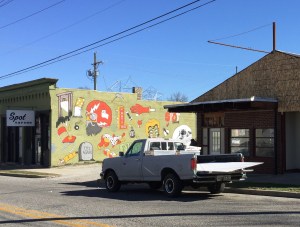
The future home of Smittybread (where that truck is parked) at 415 S. Fourth St. looks a little rough now but will soon get some TLC.

Just down the street from my house, a group of workers is turning a small commercial building into the future home of Smittybread. A lot of work remains to be done, but with perseverance and a little luck my long-fermenting business plan soon will be producing loaves of crusty sourdough bread and buttery pastries.

As with most naturally yeasted doughs, my dream of starting an artisan bakery got off to a slow, almost imperceptible start. It began Jan. 14, 2009, when I received a letter from the president of what used to be my employer, Gannett U.S. Community Publishing.

The letter said nearly every employee would be required to take a week off without pay in order to reduce company costs during an industry-wide downturn. I’d spent 26 years with the company, and it hurt to realize the future would never be the same.

Two weeks after receiving the furlough letter I purchased two books by baker and author Peter Reinhart, one titled “Bread Upon Waters,” the other “Sacramental Magic in a Small-Town Café.”

Although my memory of why I purchased those books remains dim, I can only surmise I was looking for something, anything, to take my mind off work. Some time later I purchased Reinhart’s “Crust and Crumb” and began dabbling in sourdough.

Between 2009 and 2014, the Lafayette, Ind., Journal & Courier along with many other newspapers underwent a steady decline in revenues and personnel. Dismayed by my own newspaper’s cutbacks and unable to see eye-to-eye with my boss on a variety of editorial issues, I left in June 2014 at the age of 58.

I applied for some writing and editing jobs at Purdue UniversityI found myself waking up nights wondering what I would do with the rest of my life that would give me the same sense of accomplishment as journalism. I had a feeling writing press releases wasn’t it.

Smilin' Smitty
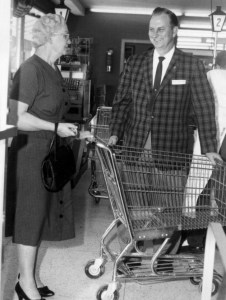
Smilin’ Smitty greets a customer in his West Lafayette supermarket.

One constant that kept turning over in my head was a love for cooking I’d inherited from my Italian-heritage mom. investigated the possibility of getting a culinary degree but decided the cost of tuition was too high. Plus, my problems with authority figures might prove lethal around so many sharp objects.

Another factor was the legacy left by my dad, known in these parts as “Smilin’ Smitty.” In the relatively short span between his service as a P-38 pilot in World War II and his untimely death in 1967, his business, Smitty’s Foodliner, gained a reputation as the area’s premier independent grocery store.

It occurred to me that with a little capital (not much more than the cost of a culinary degree, I crudely estimated) and some additional hands-on training I might parlay my penchant for making bread into a business. Not a business on the scale of Smitty’s Foodliner, but one with the same focus on quality and personal service.

In October 2014 I told my wife I was signing up for a course at King Arthur Flour titled “Setting up a Successful Bakery.” The course was taught by Jeffrey Hamelman, a baker and author whose impact on the artisan bread movement has been immeasurable. His 2004 book, “Bread: A Baker’s Book of Techniques and Recipes,” has taught and inspired many an aspiring craft baker, myself included.

He sprinkled the daylong courses with anecdotes, many humorous, but he was dead serious when he said some of us would leave the course knowing that starting a bakery might not be for them.

Jeff and me
David Smith watches Jeffrey Hamelman slice a Bee Sting cake in the King Arthur Baking Education Center in January 2015.

I wondered, was I in that category? Nevertheless, before leaving Vermont for the trip back to Lafayette, Ind., I signed up for another weeklong course the following month on advanced bread making.

That summer and next I set up a “home” bakery in a friend’s garage with equipment I’d purchased second-hand from a fraternity. I signed up as a vendor at the West Lafayette Farmers Market in 2015 and 2016, selling as much bread, croissants, brioche pastries and pretzels as I could make, sometimes with my friend’s assistance.

Indiana home-based bakers can sell bread directly to consumers at farmers markets or roadside stands but not elsewhere. Customers often would ask where they could buy my bread outside the farmers market, and I would shake my head and tell them options were limited until I could open my own commercial bakery.

If I had a donut for every time someone asked me, “So Smitty, when are you going to open your bakery?” I’d have a donut business by now.

After checking out several locations and looking into buying an existing business, I realized that opening a bakery, even a small one (or especially a small one), was harder than I had anticipated. Either the location was too inaccessible, too small, too large, ill-equipped for food service, or too pricey. And the capital costs are considerable.

Somewhere along the way I had a talk with Paul Baldwin, owner of two local food and drink establishments, The Black Sparrow, and Spot Tavern. Being a fan of good, hearty bread, and eager to promote the food and art culture locally, he suggested renting part of a building he’d recently purchased next to the Spot on South Fourth Street.

Choc cinammon rolls
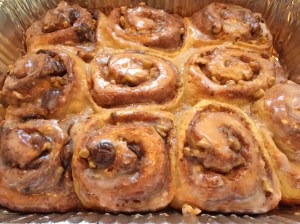
Chocolate and nut cinnamon rolls like mom used to make on Christmas day were a big hit at the holiday bake sale.

The former tattoo parlor, nee laundry, was half vacant except for the occasional visiting musicians staying overnight before or after gigs at the tavern.

In May of 2016 we hired Arkor, a local architectural and engineering firm, to draw up some preliminary plans. Paul and I split the cost.

By fall the plan had the approval of the state fire marshal, but progress slowed as the holidays approached. Meanwhile, I had a one-day bake sale that turned into my most successful day of the year, thanks in part to a recipe for chocolate and walnut cinnamon rolls my mom used to make.

As this year started, the long-fermenting project began to show visible signs of life. Paul hired a contractor to install an underground grease trap per the city’s specifications. Workers installed new dry wall on the ceilings and walls. Plumbers installed floor drains for the oven, restroom, sinks and for general cleaning purposes.

Conduits
I’m going to park a dough sheeter right about here, hence the extra outlet.

Meanwhile I lined up some equipment and working capital financing and wired funds to Pro Bake Inc. in Twinsburg, Ohio, for the purchase of a Polin bread oven made in Verona, Italy.

 This past week electricians upgraded the electrical service from 100 to 400 amps and installed conduits for myriad pieces of equipment besides the oven, such as a dough retarder/proofer and a sheeter for rolls and croissants. I’ve also been scooping up used equipment such as a three-bay sink large enough to soak sheet pans, a bread slicer and a dough divider.

While there are many more details to share, time is short and the to-do list is long. Suffice to say that bulk fermentation is nearing completion. If all goes well, we should be dividing, shaping and proofing bread at the new bakery sometime this spring. I’ll keep you posted.